
Tutkimus
Negative pressure treatment for pre- and postoperative upper extremity edema
A quality study on instrument-based negative pressure treatment and mechanical vibration for peri-operative and post-traumatic swelling in the upper extremity.
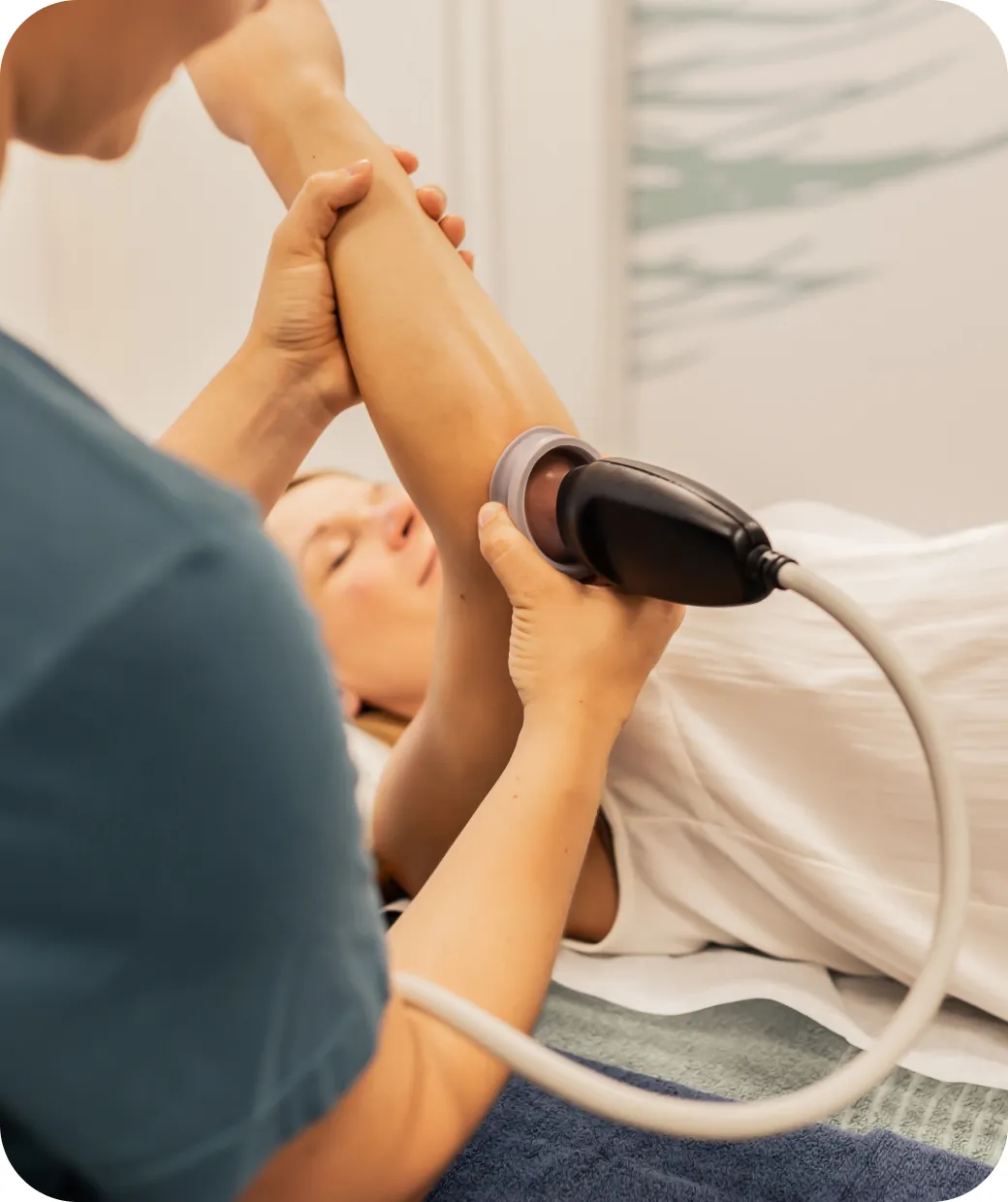
Effective peri-operative and post-operative decongestive instrument-based negative pressure treatment and mechanical vibration for anti-oedematous swelling treatment of a trauma and orthopaedic patient at the upper extremity – A quality study
Dresing, K., Fischer, A.-C., Spering, C. & Saul, D. June 2021. International Journal of Burns and Trauma.
PMID: 34336378
https://pubmed.ncbi.nlm.nih.gov/34336378/
Background: In case of traumatic or post-operative oedemas, it deals with the limited transport capacity (missing muscle pump, destruction of lymphatic channels) for congestion. Consequences of oedema are e.g. change in shape, pain, limited functionality, higher infection and wound disorders. Manual lymph drainage (MLD) is an important treatment with respect to the complex physical decongestion (CPD). MLD activates the lymph drainage and reduces the post operative complications.
Objective of the study: Evaluation whether an instrument-based negative-pressure lymph drainage (NPLD) can reduce peri-operative swelling effectively.
Methodology: Prospective study submitted to the Ethics Commission. The negative pressure was applied locally with the LymphaTouch® (LT) using a silicone-coated applicator. Treatment can be done in a local stationary manner or by using the “Lift + Twist” technique. Pressure between 20-250 mmHg was applied depending on the skin and tissue texture. The frequency was chosen between 90-70 Hz. Type of application: pulsed or continuous negative pressure treatment combined with high-frequency vibration. The process is always started in the supraclavicular fossa area, continued till the OP area at the upper extremities, duration approx. 30 min. The patient was encouraged to drink fluids after the LymphaTouch treatment (LT). The actions have been taken after the clarification, documentation of the findings (measurement, photo).
Inclusion criteria: Patient (P) with injury at the upper extremity, elective P, age > 18 years, consent. Girth measurement, movement according to NNO. Statistics: Multi-variance, Wilcoxon test not parametric.
Results: 45 P upper extremity, 3.5±1 NPLD. The swelling was more pronounced at the elbows in case of shoulder and upper arm injuries. The difference in swelling between younger and older patients (oP) was significantly less favorable for oP at the upper extremity. After 4 treatments, there was a measurable decrease in swelling of 19.9% at the UE. The reduction 15 cm prox. + direct at the elbow was significantly the best in the T-test as well as the hand mobility.
Conclusion: The perioperative and post-traumatic swelling states at the upper extremity can be sustainably and positively affected with the LT-NPLD. The pre-operative duration up to the planned operation can, likewise, be reduced like the post-operative phase. Thanks to the decrease in swelling, the patient can be operated earlier, discharged earlier and needs less analgesics.
Watch the webinar recording
Fill in your details to get instant access to the recording.