
Artikkeli
LymphaTouch in the rehabilitation of a severe burn injury
After a workplace accident caused burns to over 60% of the body, a physiotherapist used LymphaTouch to treat scar tissue from skin grafts on the backs of the hands.
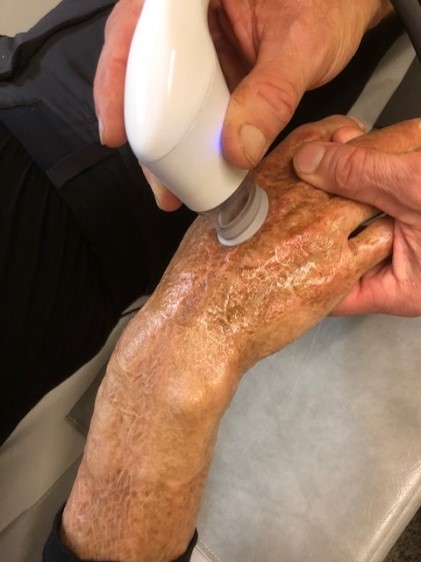
The patient had a workplace accident that caused burns to more than 60% of the body, followed by several complications. Post-traumatic physiotherapy started in May 2019.
This user experience concerns scar tissue that formed after skin grafts (both the patient's own skin and artificial skin) and the loss of range of motion it caused. The burns on the backs of the hands were extensive and required many skin grafts and artificial skin. Finger flexion was restricted: the fingertips stopped about 6 cm from the palm. Active movement was possible, but tension in the scar tissue limited both active and passive movement. The scar tissue on the backs of the hands was also very uneven.
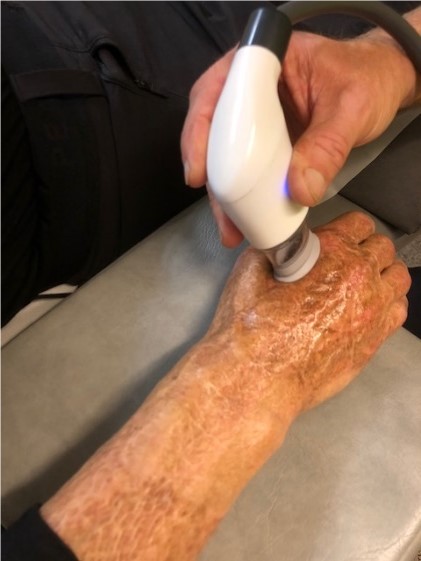
Between May 2019 and November 2020, physiotherapy for the hands consisted of moderate mobilisation because the skin was still thin. By December 2020, the skin had strengthened enough to begin treatment with LymphaTouch. The device was first used as a pre-treatment at 80 mmHg with a pulsating 35 mm treatment cup. Physiotherapy sessions took place once a week.
After only a few sessions, the patient's spouse noticed that the skin had become smoother. This was not the main goal of the physiotherapy, but it was still an important observation. As treatment continued, finger range of motion began to improve, and the negative pressure could be increased steadily up to 120 mmHg combined with mechanical vibration.
With physiotherapy and LymphaTouch, range of motion increased. Flexion of the left-hand fingers now reaches about 1 cm from the palm, and the remaining restriction does not significantly affect daily activities. The right-hand fingers flex less because of more extensive scar tissue, but finger function has returned: the elasticity of the skin and the flexibility of the scar tissue allow the patient to use tools and manage everyday tasks smoothly.
Practical observations
At first, it was difficult to get a tight contact between the treatment cup and the back of the hand. Contact improved when the therapist pushed the patient's metacarpal bones with his fingers from the palm side towards the treatment cup. As physiotherapy progressed, this was no longer necessary. The smallest treatment cup gives the tightest contact.
This user experience was shared by Ilkka Heikkilä, occupational health physiotherapist, Fysikaalinen hoitolaitos Friski.
Watch the webinar recording
Fill in your details to get instant access to the recording.